
Run Greenbelt's Voter Lookup
Start with the Maryland State Board of Elections Voter Lookup when checking your own Greenbelt voter registration. The tool matches identity and residential facts rather than browsing names. Enter the details as they appear on the registration. Results may provide the registration record, polling place, election districts, local board, sample ballot, and mail-in or provisional ballot status. Data updates daily, though a new online or motor-vehicle registration may take up to three weeks to appear.
Use the fields in this order. The exact-match design protects voter records from casual browsing, so a small difference in a name or address can prevent a result.
| Field | Type | Required | Notes / Format |
|---|---|---|---|
| First Name | Text | Yes | Letters and spaces; enter it exactly as registered |
| Last Name | Text | Yes | Letters, hyphens, and spaces |
| Date of Birth | Three numbers | Yes | Month, day, and year |
| ZIP Code | Text | Yes | Five-digit Maryland residential ZIP |
| Street Number | Text | Appears optional | Numbers and limited address characters |
| Middle Initial | Text | No | One letter |
If the Greenbelt lookup returns no match, retry the exact registered name, a prior ZIP after a move, or a former name after a name change. Then contact the local board. Do not treat a failed result as proof that someone is unregistered. The portal is meant for the voter whose facts are entered, not for scanning a neighborhood's registration list.
Note: A recent application may still be processing even when the online voter lookup has no result.
Greenbelt Voter Lookup Results
A successful personal lookup can do more than confirm active status. It routes a Greenbelt voter to the correct polling location and identifies the districts that shape the ballot. It can also show the local elections board and provide a sample ballot. During an election cycle, mail-in and provisional ballot status tools help a voter follow processing without opening the statewide roll to public name searches.
The individual tool and the voter file are different products. The first verifies a record through exact personal facts. The second is a structured data release governed by an application, oath, eligibility rule, fee, and purpose restriction. Choosing the wrong channel causes needless delay.
Fields in Maryland Voter Records
Maryland Election Law §3-101 creates one official statewide list, coordinated with local boards, precinct registers, and at least five prior years of voting history. A released voter record can be far more detailed than the personal Greenbelt lookup. The statewide product may contain these fields, subject to legal exclusions and the options chosen on the request form.
| Identity | Voter ID, name, gender, and party |
|---|---|
| Address | Residence and mailing address, except protected addresses |
| Registration | Active or inactive status and state and county registration dates |
| Precinct | Split, precinct, and county |
| Districts | Congressional, legislative, councilmanic, ward, municipal, and commissioner districts |
| Voting History | Election, participation date, method, party, precinct, location, and jurisdiction |
An inactive status is not proof that a Greenbelt resident moved for good. Maryland list maintenance uses address confirmation and federal and state procedures. Confirm current facts with the elections board before drawing a conclusion from the status field.
Protected by Maryland law. Election Law §§3-505 and 3-506 exclude Address Confidentiality Program residences from released copies. State Government §§7-309 and 7-310 also keep a participant's actual address and phone nonpublic, with narrow law-enforcement and court-order exceptions.
Greenbelt Voting History Limits
Voting history records participation, not ballot choices. A row may identify the election date and type, party, voting method, participation date, precinct, early-voting site, and jurisdiction. It never reveals how a Greenbelt voter marked a ballot. The registered-voter product includes history for up to five elections, while a separate history product can cover up to ten.
This distinction matters in family research and civic analysis. A participation entry can place a person in an election system on a date, but it cannot support any claim about that person's vote. Ballot secrecy remains intact.
Keep the inference narrow. Voter history proves recorded participation and method only. It does not disclose a candidate, question, or ballot selection.
Request Maryland's Greenbelt Voter File
Election Law §3-506 allows a copy to a Maryland registered voter who submits a written application and swears that the information will not be used for commercial solicitation or another non-electoral purpose. Use the current State Board of Elections voter-list request form. The form asks who is applying, how the information will be used, the requested geography and product, any filters, and the delivery method.
- Choose statewide data for $125, or one county, Baltimore City, or one district for $75. Select the jurisdiction or district type and number.
- Select a product and filters. Choices include a registered voter list, walking list, mail-in list, early-voting list, provisional list, cure list, party, active status, and registration-date range.
- Explain the electoral use, complete the certification, and sign the oath that bars commercial or non-electoral use and transfer or sale.
- Pay by an accepted card, check, or money order. Choose free FTP delivery, or pay $15 for flash-drive pickup or mailing.
Most data arrives as tab-separated text. Walking lists arrive as PDFs, and custom formats or data support are not offered. The State Board says a complete paid request is supplied within ten working days. Requests filed between the registration deadline and an election are returned, so submit by the 21-day advance-registration deadline or wait until after election day. Questions go to 410-269-2840 or dlPSR_sbe@maryland.gov.
Note: A returned check carries a $30 charge, separate from the product and delivery fees.
Choose Greenbelt Voter List Products
The right file depends on the electoral task. A registered-voter list can include voting history and broad district data. A walking list is a precinct PDF sorted by street, with residents and party shown under each address and even and odd sides arranged separately. It is not available statewide. Permanent and single-election mail-in products add ballot-address and processing fields. Early-voting data can show location, date, ballot style, and precinct, while provisional and cure files carry election-specific processing details.
For Greenbelt alone, select Prince George's County or the correct district and narrow the filters only when the form supports that choice. Do not expect the state to create a custom layout. The file's fixed schema is part of why a clear request matters.
Greenbelt Voter Records In Person
The Prince George's County Board of Elections is the local channel when the exact-match tool fails, when a voter needs help with a record, or when office inspection is the best route. Election Law §3-505 makes locally stored registration records open for inspection during office hours, subject to protected-address rules and special orders. Originals stay in the office unless a court orders removal or temporary processing requires it.
Prince George's Board of Elections
1100 Mercantile Lane, Suite 115A
Largo, MD 20774
301-341-7300
election@co.pg.md.us
Monday through Friday, 8 a.m. to 4:30 p.m.
Local Data Requests
The county's election data request portal provides another local route. Administrator Wendy Honesty-Bey oversees the elections office listed in the research.
List-maintenance records remain available under the Maryland Public Information Act for at least two years, except the decision not to register and the identity of a registration agency used. Broader access-law procedure belongs with Greenbelt public records requests; voter-file copies still follow the election-law oath and purpose limits.
Greenbelt's Municipal Voter Register
Greenbelt also has a city-only registration path. Ordinance 1395 took effect September 23, 2024, creating a register for resident noncitizens who cannot use ordinary state registration. An applicant must live within the city, be at least 16, and register with the Clerk at least 21 days before the city election. No political party is recorded, and the status applies only to municipal elections. State and county eligible residents continue to use Maryland's standard system.
The city form records whether the filing is new or changes a name or address. It also collects identity, date of birth, residence and mailing details, plus an eligibility affidavit. Because a Greenbelt mailing address does not by itself prove city residency, municipal boundaries matter. Current guidance is available from Greenbelt voter information or the City Clerk at 25 Crescent Road and 301-474-8000.
Route Greenbelt Election Questions
Maryland's government hub helps distinguish the State Board of Elections from county and city offices. The official Maryland state-government directory is pictured below because it shows the statewide agency-routing layer used when a Greenbelt question does not belong with the county board or City Clerk.
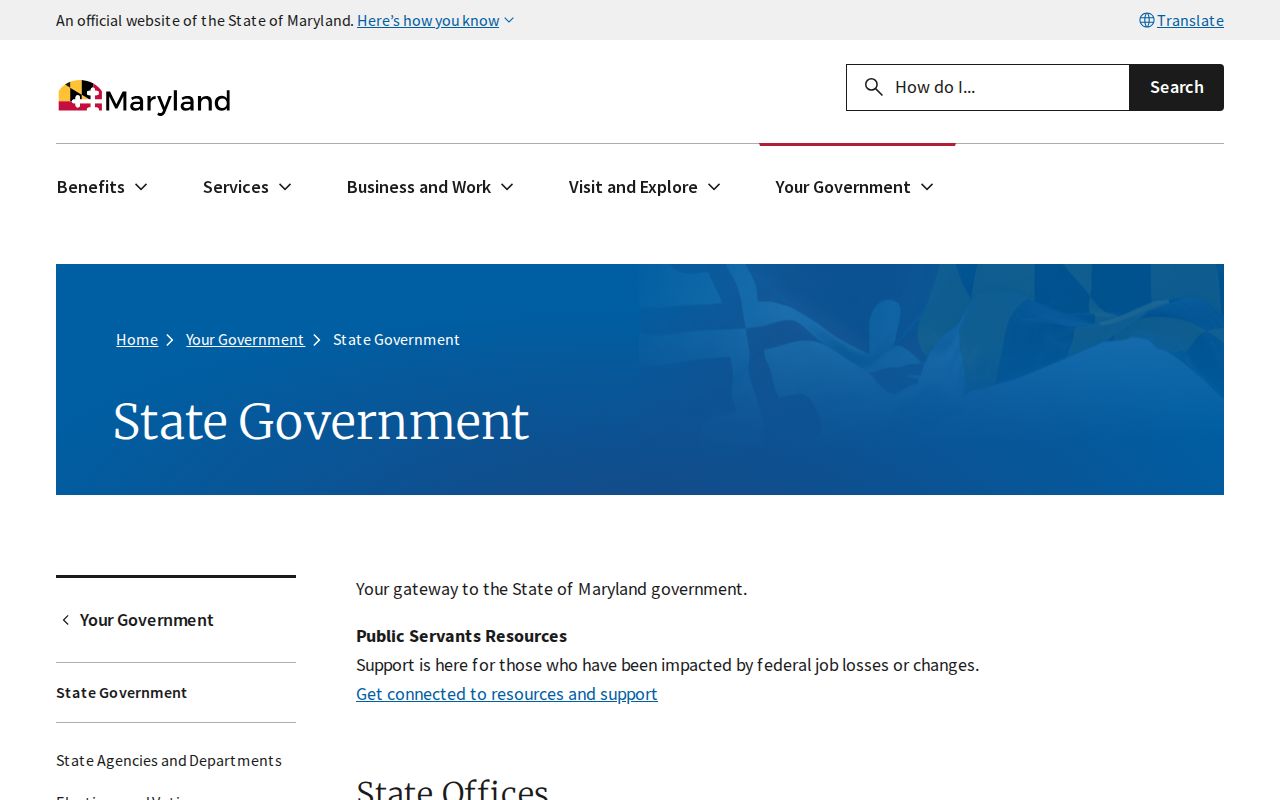
The directory is a routing aid, not a voter search. Return to the State Board's exact-match tool for personal registration, use Prince George's channels for local inspection, and contact Greenbelt's Clerk about the municipal-only register.
Trace Older Greenbelt Voter Rolls
Current web tools do not replace historical poll books and registration registers. Search older Prince George's County and municipal series through the Maryland State Archives government-record guide, then ask Archives staff or the Greenbelt Clerk where the cited series is held. The research did not establish exact online coverage years for Greenbelt poll books, so contact the custodian before planning a visit.
The city's record trail begins with its federal planning, first occupancy, and incorporation in the 1930s. A historical voter entry should be read beside municipal records, local newspapers, and archival series when identity is uncertain. An index reference may point to paper, microfilm, or an offsite series that needs advance arrangements.
Knowing misuse of a released voter list is a misdemeanor under Election Law §3-506 and COMAR 33.03.02, punishable by 30 days to six months, a fine up to $250, or both. Records access also never permits threats, surveillance, stalking, or harassment. Suspected voter-file misuse can be reported to the State Board at 410-269-2840 and the proper law-enforcement agency.